
English 
T: +86-13760465505
E: vibetop@163.com
E: vibetop@163.com
No.13, Cheng Guang Industrial park, Dafu Community, GuanLan Street, Longhua District, Shenzhen, GuangDong, China

Views: 0 Author: Site Editor Publish Time: 2026-08-29 Origin: Site


The semiconductor manufacturing environment demands absolute perfection. It features Ultra-High Vacuum (UHV) conditions, corrosive process gases, and extreme temperature cycling. Facilities leave zero margin for component failure in these critical production lines. Selecting the wrong semiconductor bellows flange ruins system hermeticity instantly. It introduces severe particulate contamination and inevitably leads to catastrophic, unplanned operational downtime. This failure stops production and destroys expensive wafers. Our guide provides a rigorous, engineering-led framework. We help you evaluate and source bellows flanges effectively. These precision components must meet strict cleanroom standards and demanding lifecycle expectations. You will learn how to match mechanical geometry to specific tool applications precisely. We also cover essential material evaluations, connection standards, and proven manufacturer vetting strategies. Read on to master precision component sourcing and protect your facility's operational uptime.
The choice between edge-welded and formed bellows dictates stroke length, footprint, and cycle life in UHV applications.
Material selection must balance mechanical flexibility with corrosion resistance; 316L stainless steel remains the baseline, but specialized alloys are required for aggressive plasma environments.
Evaluating a supplier requires looking beyond part specifications to audit their helium leak testing, cleanroom manufacturing, and quality traceability.
Proactive replacement and proper installation of custom flanged pipe assemblies are critical to mitigating system vibration and thermal expansion risks.
Every semiconductor fabrication process relies on absolute environmental control. Equipment like Chemical Vapor Deposition (CVD) and Physical Vapor Deposition (PVD) tools require flawless vacuum states. Microscopic leaks in a flange assembly destroy this vacuum integrity instantly. They allow atmospheric gases to enter the process chamber unhindered. This disruption causes immediate wafer defects and massive yield loss. Hermeticity is simply not optional in modern chipmaking.
Bellows also play a crucial mechanical role within these complex tools. They act as vital vibration isolators between moving parts. Vacuum pumps generate significant mechanical vibration during continuous operation. A properly designed bellows absorbs these harmful high-frequency vibrations effectively. They also compensate for inevitable thermal expansion in rigid semiconductor equipment components. Without this vital flexibility, rigid connections would crack under intense thermal stress.
Consider the sheer cost of sudden component failure. Fab downtime costs thousands of dollars per minute. Emergency maintenance disrupts entire production schedules and wastes expensive raw materials. Compare this against the relatively low procurement price of a high-purity flange. Investing in premium quality yields exceptional returns for facility managers. You protect costly wafer output and maintain steady operational flow. Reliable parts secure consistent semiconductor manufacturing success over the long term.
Engineers choose between two main manufacturing techniques for bellows construction. You must match the physical geometry to your specific application requirements.
Manufacturers create formed bellows by pressing or rolling seamless metal tubes.
Characteristics: They feature thicker walls and offer extremely high pressure tolerance. They are inherently less flexible than edge-welded alternatives due to material thickness.
Best for: Use them primarily as static expansion joints. They suit high-pressure liquid or rough gas delivery lines perfectly. They work well for budget-sensitive applications requiring only minimal axial movement.
This advanced process welds individual stamped metal diaphragms together.
Characteristics: They are ultra-flexible and offer a highly compact footprint. They deliver extreme stroke lengths in both compression and extension. They do this while maintaining perfect vacuum integrity under dynamic stress.
Best for: Deploy them in highly dynamic applications. They excel in wafer handling mechanisms, lift pins, and precision semiconductor actuators.
Use the comparison chart below to guide your component choice. Compare upfront costs against required cycle life and spatial constraints inside the tool.
Formed vs. Edge-Welded Bellows Comparison
Evaluation Criteria | Formed Metal Bellows | Edge-Welded Bellows |
|---|---|---|
Flexibility & Stroke | Low to Moderate stroke capacity | Extremely High stroke capacity |
Initial Procurement Cost | Generally Lower | Higher due to complex welding |
Dynamic Cycle Life | Limited under frequent movement | Exceptional (Millions of cycles) |
Space Required (Footprint) | Requires larger operating footprint | Highly compact design |
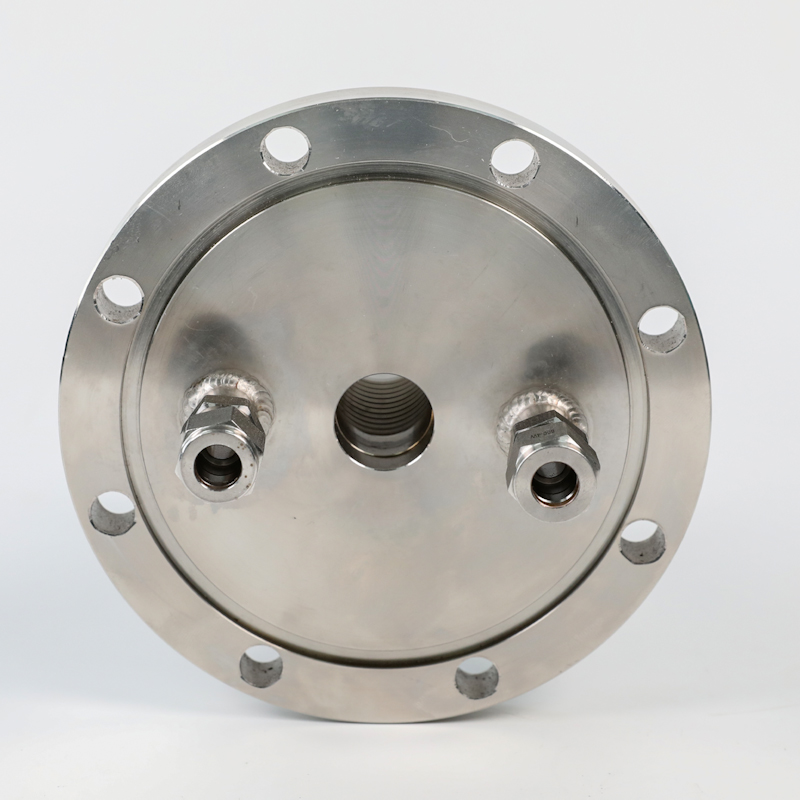
Evaluating these components requires strict attention to detail and material science. Standard industrial parts will fail rapidly in aggressive fab conditions.
Standard commercial alloys often fall short in semiconductor environments. We use 316L or 316LN stainless steel semiconductor parts for baseline UHV applications. These grades feature low carbon content to minimize precipitation during welding. Aggressive etch gases require even stronger, highly specialized materials. Engineers often specify Inconel or Hastelloy to resist corrosive plasma environments. These exotic alloys prevent dangerous particulate shedding during plasma exposure.
Your chosen connection type directly dictates maximum vacuum capability. Consider these three main industry standards:
CF (ConFlat) Flanges: Essential for ultra-high vacuum environments. They use crushable copper gaskets and handle extreme bake-out temperatures flawlessly.
KF/NW Flanges: Best for rough to high vacuum delivery lines. They use elastomer O-rings and centering rings for quick manual assembly.
ISO Flanges: Used heavily for larger diameter high-vacuum lines. They support modular system designs and use clamp or bolt fasteners.
Mean Time Between Failures (MTBF) data determines your critical preventive maintenance schedules. You must calculate expected component lifespan accurately before installation. Factor in the required mechanical stroke length for every cycle. Include operating temperatures and internal pressure differentials. Extreme temperatures severely reduce the total cycle fatigue limit. Aggressive pressure differentials also accelerate mechanical wear and shorten part life.
Surface finish directly impacts outgassing rates and vacuum performance. Rough surfaces trap microscopic moisture and harmful chemical contaminants easily. We require extensive electropolishing for all internal vacuum surfaces. Parts must undergo strict cleanroom-certified washing and drying procedures. This precise cleaning prevents harmful outgassing within the process chamber. It also stops microscopic particulate shedding during continuous dynamic operation.
Proper installation procedure is just as important as part selection. Even premium components fail if technicians install them incorrectly.
Mechanical stress introduced during installation destroys bellows integrity immediately. Torsional stress remains the most common and damaging installation error. Technicians accidentally twist the fragile bellows while tightening heavy flange bolts. This twisting creates immediate micro-leaks along the delicate weld seams. Improper torque sequences on rigid custom flanged pipe assemblies also warp flanges. Always follow standard star-pattern torque specifications during assembly. Use calibrated precision torque wrenches for every single bolt.
Engineers sometimes specify unnecessarily extreme tolerances for simple applications. They might demand excessive stroke lengths for static expansion joints. Some request expensive exotic materials for benign nitrogen gas lines. Over-specification inflates upfront project costs dramatically. It also extends manufacturing lead times for no real functional gain. Match the component specifications strictly to actual physical operating requirements.
Ignoring established cycle-life limits poses a massive operational risk. Metal bellows do not last forever in high-speed dynamic applications. They will eventually experience metal fatigue and structural failure. You must establish a strictly data-driven replacement schedule. Track cycle counts meticulously within your fab equipment software. Proactive maintenance preserves overall system reliability and facility output. It prevents catastrophic vacuum loss mid-process and saves valuable wafers.
Your supply chain quality dictates your final equipment reliability. Vetting manufacturers requires strict, uncompromising auditing processes.
Never accept assumed specifications from a new supplier. Demand documented leak testing for all purchased semiconductor bellows flanges. Suppliers must use highly sensitive Helium mass spectrometer leak testing equipment. The strict industry standard demands leak rates below 1x10^-9 atm cc/sec. Every single delivered part must pass this rigid validation check.
Contamination introduced during factory assembly renders good parts useless. Verify the supplier operates certified ISO Class cleanrooms. They must assemble, test, and package components inside these controlled environments. This pristine handling ensures out-of-the-box readiness for your cleanroom fab. Finished parts should arrive double-bagged and safely backfilled with inert nitrogen.
Material purity is critical for maintaining long-term UHV stability. Demand complete material test reports (MTRs) for every incoming heat lot. Ensure the manufacturing supplier holds active ISO 9001 quality certification. They must follow strict copy-exact manufacturing protocols without deviation. You need absolute consistency from batch to batch. Any unapproved manufacturing change can ruin your entire process yield.
Evaluate the technical expertise of your potential component supplier carefully. Do they only sell standard off-the-shelf catalog items? Leading manufacturers offer deep co-engineering support for complex projects. They help design bespoke form factors for tight spatial constraints. They accurately calculate complex motion profiles to guarantee expected cycle life. Partnering with strong engineering teams reduces long-term operational risks significantly.
Selecting the right bellows flange requires moving past basic dimensional fit. You must rigorously evaluate metallurgical purity and weld integrity. Analyze specific motion profiles to determine cycle life. Prioritize rigorous testing and cleanroom assembly for every component.
Take these action-oriented next steps today:
Audit your current MTBF data across all fab tools.
Assess any ongoing vacuum leak issues causing yield loss.
Engage a qualified manufacturer for a comprehensive technical review.
Update your installation procedures to eliminate torsional stress risks.
A: The industry standard typically requires leak rates below 1x10^-9 mbar L/s. Manufacturers must verify this using helium mass spectrometer leak testing. Strict testing ensures ultimate vacuum integrity and prevents atmospheric contamination in the process chamber.
A: Yes, you can use them in static environments or rough vacuum lines. However, dynamic UHV environments usually require edge-welded options. Welded designs offer better flexibility and longer cycle life under extreme vacuum conditions.
A: Base replacement on predictive maintenance data. Track actuator cycle counts against the manufacturer’s rated limits. You should also monitor the system for microscopic vacuum degradation. Replace components proactively before total failure occurs.
A: The "L" stands for low carbon content. This prevents carbide precipitation during the welding process. It ensures excellent corrosion resistance and limits outgassing in UHV environments. This makes it the baseline material for semiconductor applications.


