
English 
T: +86-13760465505
E: vibetop@163.com
E: vibetop@163.com
No.13, Cheng Guang Industrial park, Dafu Community, GuanLan Street, Longhua District, Shenzhen, GuangDong, China

Views: 0 Author: Site Editor Publish Time: 2026-08-24 Origin: Site


Manufacturing engineers face a constant dilemma when designing high-performance components. Pure copper delivers superior electrical and thermal conductivity, making it an industry standard. However, it presents severe machining challenges. Operators regularly battle gummy, stringy chips and rapid tool wear. These manufacturing hurdles often lead to scrapped parts and skyrocketing production costs. You need a material solution balancing performance and manufacturability.
To solve this, engineers turn to an innovative alloy. C14500, widely known as Tellurium Copper, acts as a high-machinability alternative. It impressively retains between 90% and 93% of pure copper's baseline conductivity. We designed this guide to provide objective machining parameters, tooling strategies, and vendor evaluation criteria. By reading further, you will discover actionable methods for c14500 tellurium copper machining. You will also learn exactly how you can reliably source high-precision components for demanding engineering applications.
Machinability Leap: C14500 boasts an 85% machinability rating compared to pure copper’s 20%, drastically reducing cycle times and tooling costs.
Chip Control: The addition of 0.5% tellurium creates short, brittle chips, eliminating the "bird-nesting" typical of unalloyed copper.
Ideal Use Cases: Best suited for high-volume CNC turning and milling where thermal/electrical conductivity is non-negotiable (e.g., semiconductor equipment components).
Sourcing Reality: Higher raw material costs are typically offset by reduced machining time, but specialized tooling and strict coolant protocols are required to hold tight tolerances.
Material selection heavily influences both final part performance and shop floor efficiency. Engineers must carefully evaluate the conductivity-to-machinability trade-off before finalizing CAD prints. Choosing the wrong alloy often results in catastrophic production delays or compromised electrical efficiency.
When we compare C14500 against C11000 (Pure Copper), the operational differences become immediately clear. Pure copper requires painfully slow feeds. Operators must frequently pause CNC spindles to clear stringy chips from the cutting zone. This constant intervention causes significant spindle downtime and increases the rate of scrapped parts. Conversely, tellurium copper allows for high-speed, automated CNC runs. You achieve better surface finishes while running machines continuously.
We must also address the performance gap when comparing C14500 to C36000 (Free-Machining Brass). Brass is noticeably cheaper and highly machinable. Many buyers instinctively gravitate toward it for high-volume production. However, brass simply cannot meet the rigorous thermal or electrical transfer requirements of critical power components. Its electrical conductivity maxes out around 28% IACS. Tellurium copper bridges this gap perfectly, offering near-pure copper conductivity alongside excellent machinability.
Table 1: Material Comparison for Precision Machining
Material Grade | Machinability Rating | Electrical Conductivity (IACS) | Common Machining Characteristics |
|---|---|---|---|
C11000 (Pure Copper) | 20% | 100% | Gummy, stringy chips; high tool wear; requires slow feeds. |
C14500 (Tellurium Copper) | 85% | 90% - 93% | Short, brittle chips; enables automated, lights-out machining. |
C36000 (Free-Machining Brass) | 100% | 28% | Excellent chip control; poor thermal and electrical transfer. |
We acknowledge the premium raw material cost associated with tellurium copper. Buyers often experience initial sticker shock when procuring C14500 billets. However, you must view this through the lens of production efficiency. The material premium is quickly negated in complex copper semiconductor parts. If you used C11000, cycle times would be prohibitively long. Yield rates would plummet due to tool breakage and poor surface finishes. By reducing machining time by up to 60%, tellurium copper delivers a highly favorable return on investment for high-precision manufacturing.
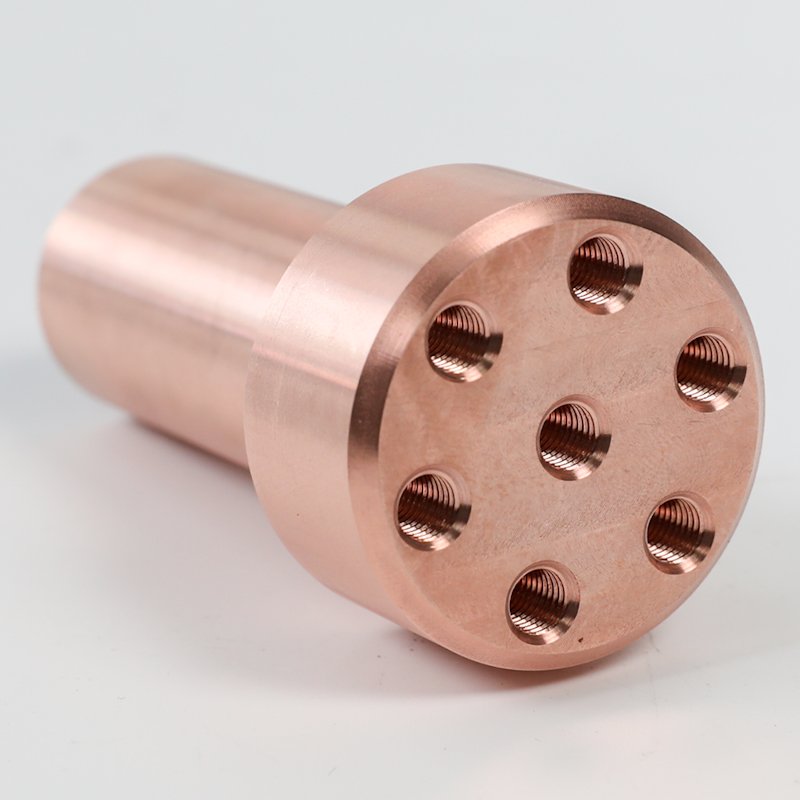
Achieving tight tolerances requires strict adherence to optimized CNC parameters. You cannot simply apply aluminum or steel cutting data to copper alloys. Success demands a nuanced understanding of speeds, feeds, and material behavior under stress.
For milling operations, spindle speeds and table feeds play a critical role. We recommend maintaining relatively high surface speeds, often ranging between 800 and 1,200 SFM (Surface Feet per Minute). Interestingly, aggressive feeds often perform much better than conservative ones. Pushing the tool harder ensures the chip breaks cleanly against the flute. Light, hesitant cuts cause the copper to rub against the cutting edge, generating massive friction and accelerating tool wear.
During turning operations, you must carefully balance your depth of cut and feed rates. Guidelines suggest keeping the depth of cut substantial enough to get under the work-hardened layer from previous passes. If you take excessively light finishing passes, the material will push away rather than shear. This pushing action induces excess work hardening, instantly destroying your dimensional accuracy.
To understand why C14500 machines so beautifully, we must look at its microstructure. The addition of roughly 0.5% tellurium changes everything. Tellurium does not dissolve into the copper matrix. Instead, it forms distinct copper telluride particles dispersed throughout the alloy. These particles act as an internal solid lubricant and a natural chip breaker.
This microstructural advantage provides a massive operational benefit. As the cutting tool engages the material, the chip hits a telluride inclusion and snaps. This mechanism enables uninterrupted, lights-out manufacturing. It completely prevents the chip-clogged flutes typically seen when milling unalloyed copper, allowing operators to run multiple machines confidently.
Even the most machinable copper alloy will fail if paired with incorrect tooling. Copper is notoriously sticky. It readily adheres to cutting tools if you ignore geometry and coating fundamentals.
We strongly recommend using polished, uncoated micro-grain carbide inserts. If you prefer coated tools, select specialized options like TiB2 (Titanium Diboride) or Diamond-Like Carbon (DLC). These specific coatings possess extremely low coefficients of friction. They prevent Built-Up Edge (BUE), a condition where copper pressure-welds itself to the cutting tool.
You must highlight and avoid a common industry risk. Never use standard High-Speed Steel (HSS) tools or aggressively coated tools (like TiAlN) meant for hardened steel. These steel-focused coatings contain aluminum, which chemically reacts with copper at high temperatures. This reaction causes the copper to gall or permanently weld to the cutting edge, destroying the tool and the workpiece.
Tool geometry dictates how efficiently the material shears. We specify the absolute need for sharp, positive rake angles. Positive rakes reduce cutting forces and slice cleanly through the tellurium copper matrix. You want to shear the material cleanly rather than pushing it.
Common edge preparations like heavy hones or T-lands are detrimental here. A blunt edge will compress the copper, generating excessive heat and poor surface finishes. Always insist on up-sharp cutting edges for your custom components.
Thermal management is non-negotiable. Copper transfers heat incredibly well, meaning the workpiece will rapidly absorb heat from the cutting zone if not properly cooled.
High-Pressure Coolant: Utilize high-pressure systems to blast chips out of deep cavities. This evacuates heat immediately and maintains strict temperature stability.
Concentration Levels: Keep water-soluble coolant concentrations between 8% and 10% to provide adequate lubricity.
Sulfur Warnings: Strictly avoid active-sulfur cutting fluids. Active sulfur chemically attacks copper, creating a dark copper sulfide tarnish. This will permanently stain or corrode your c14500 copper machined parts.
The semiconductor industry operates under some of the most unforgiving manufacturing standards globally. Components placed inside wafer fabrication equipment must meet extreme purity and precision benchmarks. Standard commercial machining practices often fall short.
When producing semiconductor spare parts, you must navigate several specific demands. These include strict vacuum compatibility, zero-particle generation, and immense thermal cycling stability. The components often operate in Ultra-High Vacuum (UHV) environments. Any microscopic burr, embedded particulate, or residual machining oil can contaminate a multi-million dollar silicon wafer batch.
Purity begins at the raw material level. You must explain the critical importance of specifying oxygen-free or strictly deoxidized grades of C14500. Standard copper contains trace amounts of oxygen. If exposed to high-heat operations or vacuum brazing in a hydrogen-rich atmosphere, the hydrogen reacts with the oxygen to form steam. This steam ruptures the metal matrix, causing severe hydrogen embrittlement.
Furthermore, precision machining actively controls surface finishes to limit outgassing in vacuum chambers. A rough surface traps gas molecules, which slowly release (outgas) when a vacuum is pulled. Machinists must hold single-digit Ra surface finishes to minimize surface area and prevent this phenomenon.
Shop-floor realities dictate how these parts are processed. Semiconductor equipment components must be machined in environments that strictly isolate copper from incompatible metals. If a machine previously cut aluminum or certain carbon steels, microscopic dust remains in the coolant tank.
When you machine C14500 in that same equipment without a complete teardown, those dissimilar metal particles embed themselves into the soft copper surface. This directly causes galvanic corrosion or particulate contamination later in the component's lifecycle. Premium machining partners dedicate specific CNC centers exclusively to copper and specialized alloys.
Sourcing precision tellurium copper parts is an exercise in risk management. You cannot simply award contracts based on the lowest hourly rate. You must meticulously evaluate a vendor's technical capabilities and quality infrastructure.
Begin by auditing the shop’s historical data. Verify their experience with copper feeds, speeds, and complex geometries. Ask to see their tooling inventory. Do they have dedicated copper-cutting geometries, or do they plan to use general-purpose end mills? A qualified vendor will gladly showcase their specialized polished carbide tooling and high-pressure coolant setups.
Next, look for rigid inspection protocols. Copper's high thermal expansion coefficient makes it tricky to measure accurately if the part is still warm from machining. The vendor must have climate-controlled metrology labs. Pay special attention to their ability to verify surface finish (Ra) and guarantee dimensional stability post-machining.
Never compromise on material verification. Ensure the vendor provides full Material Test Reports (MTRs) directly from the producing mill. These documents guarantee the exact alloy composition. More importantly, they verify the deoxidized status required for sensitive semiconductor applications. Counterfeit or lower-grade copper will fail catastrophically in the field.
To safely shortlist a new vendor, follow a structured prototype phase:
Request a small batch of prototypes focusing solely on the most critical features.
Test their ability to machine deep tapped holes without tap breakage.
Evaluate their ultra-fine surface finishes under magnification.
Verify their packaging methods to ensure parts arrive oxidation-free.
Successful tellurium copper manufacturing hinges on marrying the right alloy grade with optimized, razor-sharp tooling. By understanding the unique mechanics of C14500, you can bypass the historical frustrations of machining pure copper. You eliminate gummy chips, prevent premature tool failure, and maintain exceptional dimensional accuracy across long production runs.
Ultimately, this strategy bridges the gap between high-end electrical and thermal performance and viable, scalable manufacturing. You no longer have to sacrifice manufacturability to hit conductivity targets. If you face challenges with complex copper geometries, we encourage you to act today. Prompt your engineers or buyers to submit RFQs, 3D CAD files, or technical drawings for a comprehensive manufacturability review.
A: Generally, no. C14500 retains its mechanical properties exceptionally well post-machining. It responds predictably to standard annealing and stress-relieving processes if needed for specific forming operations. However, for most standard CNC milled or turned components, the material is used in its supplied half-hard or hard state without requiring secondary thermal treatments.
A: Yes, C14500 is generally considered RoHS compliant. Tellurium is not currently restricted under standard RoHS directives, and the alloy is inherently lead-free. However, trace elements can vary by manufacturer. You must always request and verify specific mill certifications (MTRs) to guarantee full environmental compliance for your specific industry.
A: Soldering and brazing C14500 are rated as "good" to "excellent," making it highly suitable for electrical connections. However, traditional welding (such as gas or arc welding) is not recommended. The tellurium content can cause hot shortness and cracking within the weld zone, severely compromising the structural integrity of the joint.


