
English 
T: +86-13760465505
E: vibetop@163.com
E: vibetop@163.com
No.13, Cheng Guang Industrial park, Dafu Community, GuanLan Street, Longhua District, Shenzhen, GuangDong, China

Views: 0 Author: Site Editor Publish Time: 2025-11-05 Origin: Site


CNC machining is revolutionizing manufacturing across industries. But how does it work, especially in the automotive sector?
In this article, we'll explore how CNC machining automates the production of car auto parts. From the basics to the benefits, you’ll learn how it shapes the future of precision manufacturing.
CNC machining is a subtractive manufacturing process, meaning material is removed from a raw workpiece to create a desired shape. The process is controlled by pre-programmed computer software, which sends specific commands to the machine, dictating its movements and operations.
In the automotive sector, CNC machining is indispensable for making car auto parts. For example, a CNC machine can mill an aluminum block to create engine parts with precision that would be nearly impossible to achieve with manual tools.
CNC machining has evolved significantly since its inception in the 1940s. Initially, manufacturing relied heavily on manual operations, which were slow and prone to errors. The introduction of CNC machines automated these processes, allowing for faster, more consistent production.
For car manufacturers, this evolution meant that parts such as engine blocks, gearboxes, and exhaust systems could be produced with improved efficiency and tight tolerances.
A CNC machine consists of several essential components:
● Control Unit: The brain of the machine, where the program is fed, and instructions are processed.
● Motors: Control the movement of the machine’s components along different axes (X, Y, Z).
● Tools: Cutting tools that shape the material, such as mills, lathes, or drills.
● Spindle: Holds the cutting tool and rotates it to cut the material.
Each part plays a crucial role in ensuring that the CNC machine operates precisely, which is vital for producing high-quality car auto parts.
CNC machining begins with Computer-Aided Design (CAD). CAD software allows designers to create a 3D digital model of the part they want to produce. This model defines the part's geometry, dimensions, and any specific features required for functionality.
For car auto parts, CAD models ensure that parts like brake pads, pistons, or chassis components are designed with precise specifications. These designs are then used as blueprints for the CNC machine.
Once the CAD model is ready, the next step is converting it into G-code, a computer language used to control the CNC machine. This code instructs the machine on how to move, what speed to use, how deep to cut, and other critical details of the machining process.
For example, when manufacturing a car's suspension component, the G-code ensures that the CNC machine cuts with the exact dimensions and tolerances required for the part to fit seamlessly into the vehicle's assembly.
Before machining begins, the CNC machine must be properly set up. This includes securing the raw material onto the machine bed, installing the appropriate tools (such as drills or mills), and verifying that everything is calibrated.
In the case of car auto parts, the raw material (such as steel or aluminum) is loaded onto the CNC machine, ready for machining. Tools are selected based on the specific tasks the machine will perform, such as cutting, drilling, or turning.
Once everything is set up, the CNC machine follows the G-code instructions, cutting and shaping the material to create the final part. The process is fully automated, with minimal human intervention required.
For instance, a CNC lathe might rotate a piece of metal to create a perfectly cylindrical part, like a car's axle or shaft. A CNC milling machine, on the other hand, would use rotating cutting tools to shape a complex automotive component, like a gear or valve body.
One of the most significant advantages of CNC machining in automotive manufacturing is its ability to produce highly precise parts. From engine components to structural parts, CNC machines can create components with tight tolerances, ensuring they fit perfectly and perform optimally.
Car auto parts like pistons, engine blocks, and camshafts require very specific dimensions and surface finishes. CNC machining ensures that these parts meet the high standards of the automotive industry, offering durability and functionality.
CNC machining offers numerous benefits for car manufacturers:
● Reduced Lead Times: Since CNC machines automate the production process, they significantly reduce the time it takes to produce parts.
● Consistency and Precision: CNC machining ensures that each part produced is identical to the last, which is crucial in mass production.
● Cost-Effectiveness: While CNC machines require an initial investment, they lower production costs in the long run by improving efficiency and reducing waste.
For example, when mass-producing car components like brake discs, CNC machining ensures each disc meets the required quality standards without the need for frequent retooling.
CNC machining is used in various aspects of automotive production, from creating engine components like cylinder heads to suspension parts like shock absorbers and brake system components. These parts must be manufactured to exact specifications, and CNC machining guarantees their quality.
The ability to produce high-quality, intricate parts consistently has made CNC machining a cornerstone in the automotive manufacturing process.
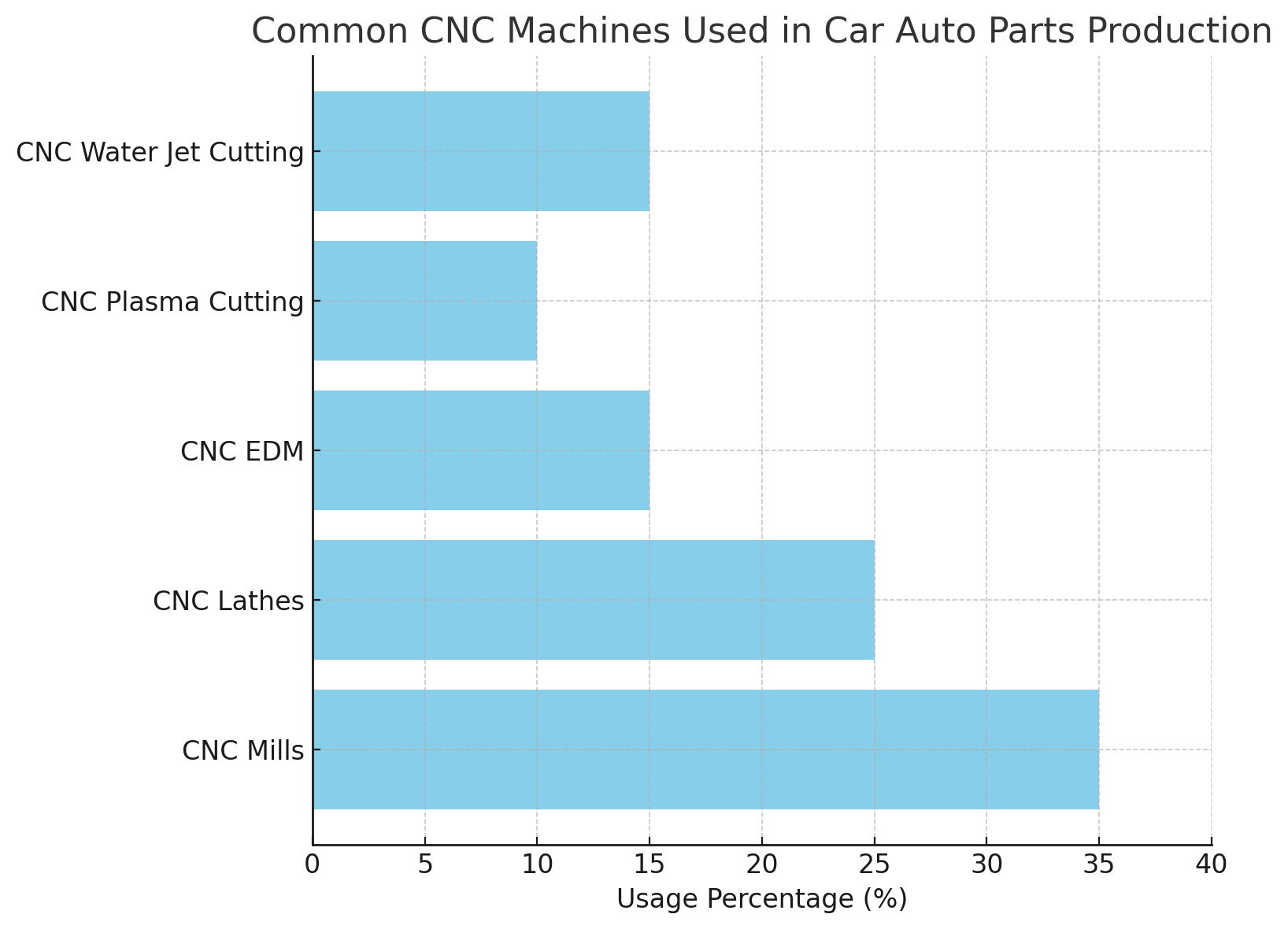
CNC milling machines use rotating cutting tools to remove material from a stationary workpiece. They are essential in producing complex automotive parts with high precision.
For instance, car components like transmission cases and engine blocks are often produced using CNC mills, which can handle intricate cuts and provide smooth finishes.
CNC lathes are used to produce cylindrical parts by rotating the workpiece while a stationary cutting tool shapes it. These machines are ideal for creating parts like axles, shafts, and pins commonly found in automotive applications.
CNC lathes offer high precision, ensuring that parts fit perfectly within the larger assembly of the vehicle.
CNC plasma and water jet cutters are used for cutting large, tough materials, such as sheet metal. In the automotive industry, these machines are often employed for cutting body panels, brackets, and other metal parts that require strength and durability.
Water jet cutters are particularly useful when cutting materials sensitive to heat, as the process does not generate heat that could alter the material's properties.
Electrical Discharge Machining (EDM) uses electrical sparks to erode material from a workpiece. This method is especially useful for producing precise features in hard metals used in car parts.
For example, EDM is commonly used to create intricate gear teeth or tooling components, ensuring that these parts maintain their functionality under high stress.
CNC machining guarantees tight tolerances and precision that is critical for automotive components. Whether producing engine parts or transmission gears, the accuracy of CNC ensures that every component fits perfectly and performs to standard.
By automating the manufacturing process, CNC machining reduces the time required to produce each part. This is especially important in mass production, where time and consistency are of the essence.
For example, producing hundreds of thousands of identical brake discs or suspension arms is made possible through CNC, improving both production speed and efficiency.
CNC machining is highly cost-effective for large-scale automotive production. It minimizes material waste and reduces the need for manual labor, both of which help lower production costs.
For instance, CNC machines can produce vehicle body parts in high volumes while maintaining precision, ensuring cost savings for car manufacturers.
As the automotive industry embraces smart manufacturing, CNC machining is expected to integrate with advanced technologies like AI, robotics, and 3D printing. These advancements will enable even greater automation and precision, particularly in the production of parts for electric and autonomous vehicles.
Electric and self-driving vehicles require specialized components, and CNC machining will play a crucial role in producing these parts. From battery housings to sensors, CNC will ensure that each component meets the demanding requirements of electric vehicles.
As sustainability becomes a priority, CNC machining will evolve to reduce energy consumption and material waste. Innovations such as energy-efficient machines and recycling of materials will help manufacturers reduce their environmental impact while maintaining the quality of their car auto parts.
CNC machining is crucial in manufacturing car auto parts, ensuring precision and cost-efficiency. It produces high-quality, complex components such as engine parts and suspension systems that are essential for vehicle performance. As the technology advances, it will play an even larger role in producing parts for electric and autonomous vehicles. Shen Zhen Vibetop Technology offers reliable CNC machining services, helping manufacturers meet the growing demand for high-precision automotive components.
A: CNC machining is a manufacturing process that uses computer programming to control machine tools. It automates tasks like cutting, drilling, and shaping materials with high precision, commonly used in producing car auto parts.
A: CNC machining automates the creation of complex car auto parts, such as engine components and suspension systems, by using pre-programmed software to guide machine tools for precise shaping and cutting.
A: CNC machining provides high precision, consistency, and efficiency, essential for producing car auto parts like gears and brackets, which require tight tolerances and intricate designs.
A: Common CNC machines used in automotive manufacturing include CNC mills, lathes, and EDM machines. These tools ensure the accurate production of car auto parts like axle shafts and engine blocks.
A: CNC machining reduces material waste and improves production efficiency, which lowers costs. It ensures consistent high-quality production of car auto parts, minimizing rework and errors.
A: Yes, CNC machining is ideal for creating intricate car auto parts designs, such as those for engine blocks or suspension systems, due to its ability to produce parts with high precision and tight tolerances.


